


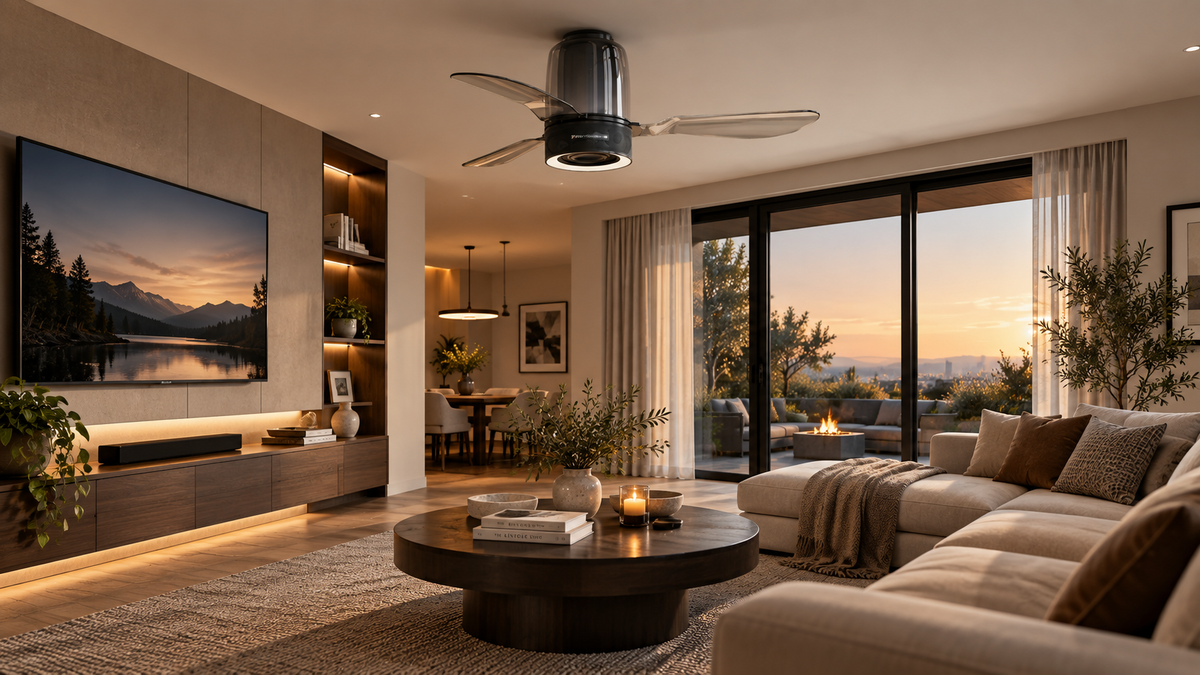
CEDIA Expo 2026 may be over, but the attention around AirFi One has continued well beyond the show floor.
In the weeks surrounding and following the event, AirFi One began appearing across well-known technology, design, smart home, and lifestyle media. Geeky Gadgets explored its combination of Hi-Fi sound, lighting, and airflow. Digital Trends looked at AirFi One through the idea of creating a smarter home with fewer separate devices. Yanko Design focused on how an 80W Hi-Fi speaker and smart lighting could be integrated into a ceiling fan. Coverage also appeared through The Globe and Mail and ACCESS Newswire.
For us at WindGroove, the most meaningful part is not simply that AirFi One has received media attention.
It is what people are paying attention to.
The conversation has quickly moved beyond the novelty of putting a speaker inside a ceiling fan. Instead, people are beginning to ask the same question that led us to create WindGroove in the first place.
Why has one of the largest surfaces in our homes been asked to do so little?
That question is at the heart of AirFi One.

AirFi One in the Press
Seeing AirFi One discussed by different publications has given us an interesting view of how people understand the product.
Each publication approaches it from a slightly different angle, but many arrive at a similar idea: the ceiling may have much more potential than we normally give it.
Geeky Gadgets — a well-known technology publication focused on innovation
Geeky Gadgets looks at AirFi One as more than a conventional ceiling fan, highlighting the integration of sound, lighting, airflow, and smart controls within a single overhead system.
The article also explores a broader question that closely reflects our thinking at WindGroove: instead of continually adding more individual devices to a room, could one well-integrated product take on several roles at once?
Read the full story:
WindGroove AirFi One: The World’s First Hi-Fi Ceiling Fan Speaker Redefines Smart Home Entertainment
Digital Trends — a leading consumer technology media outlet
Even the title captures an important part of the AirFi One philosophy.
Smart homes have become increasingly capable, but they have also become filled with more devices. Speakers, lamps, fans, hubs, controllers, and other hardware often compete for the same physical space.
AirFi One suggests another possibility: making technology more integrated into the architecture of the room instead of simply adding another object to it.
Read the full story:
WindGroove’s AirFi One imagines a smarter home with fewer devices
Yanko Design — a globally recognized design and innovation publication
Yanko Design approaches AirFi One from both a technology and industrial design perspective, focusing on the challenge of combining audio, lighting, and airflow without turning the product into a collection of visibly separate components.
The article also currently includes a publication-specific AirFi One offer for readers.
Read the full story:
This ceiling fan hides an 80W Hi-Fi speaker and smart lighting in one sleek unit
The Globe and Mail — a leading Canadian national news organization
AirFi One was also introduced to a broader business and investment audience through coverage carried by The Globe and Mail via ACCESS Newswire.
The story presents AirFi One as a ceiling-based home entertainment system combining Hi-Fi sound, lighting, and airflow.
Read the coverage:
ACCESS Newswire — a professional global news distribution platform
ACCESS Newswire introduced the wider idea behind AirFi One, including WindGroove's Ceiling Vibe System™, its acoustic development with Jamo, and our belief that the ceiling can become an active experience layer within the home.
Read the full story:
New Atlas — a leading technology and innovation publication
New Atlas explores AirFi One as a new approach to connected living, focusing on how the ceiling can become more than a place for traditional fixtures.
The article highlights WindGroove’s vision of combining high-fidelity audio, lighting, airflow, and smart control into a single ceiling-based system instead of adding more standalone devices throughout the home.
From its three-way acoustic design developed with Jamo to the idea of transforming the ceiling into an active experience layer, New Atlas examines how AirFi One rethinks the role of everyday home technology.
Read the full story:
Meet WindGroove AirFi One: The World’s First Hi-Fi Ceiling Vibe System™
XDA Developers — a technology publication focused on smart devices
XDA Developers introduces AirFi One from a smart home perspective, highlighting how a single ceiling-mounted system can combine multiple functions that are traditionally handled by separate devices.
The coverage explores AirFi One as more than a ceiling fan, focusing on its ability to bring together airflow, lighting, audio, and smart controls within one integrated home experience.
The article reflects a growing shift in smart home design: moving away from adding more hardware and toward creating technology that blends naturally into the living environment.
Read the full story:
WindGroove AirFi One: The Smart Home Hub You Didn’t Know You Needed
Some media features may also include exclusive AirFi One reader offers. Availability, discount levels, and promotional periods can vary by publication, and some offers are available only for a limited time.

More People Shared the Idea Than We Expected
Media coverage is one form of validation.
The response from people themselves has meant even more.
When we introduced AirFi One on Kickstarter, the initial crowdfunding goal was only $10,000.
We knew that we believed in the concept, but there was no guarantee that other people would look at the ceiling the same way we did.
The response quickly went far beyond that original target.
Hundreds of backers supported AirFi One, demonstrating that the idea of bringing sound, light, and airflow together in one ceiling-based system was not something only our team had imagined.
That surprised us.
More importantly, it encouraged us.
We realized that many people shared the same feeling: modern homes have gained more technology, but that technology does not always need to mean more boxes, more cables, more devices, and more visual clutter.
To everyone who supported AirFi One, shared it, talked about it, or simply believed in the idea, thank you.
You helped confirm something we had suspected from the beginning.
The ceiling still has room to evolve.
The Fifth Wall Has Been Overlooked
When people think about designing a room, almost every surface receives attention.
We choose flooring carefully. We decorate the walls. We think about furniture, artwork, storage, televisions, lighting, and even the smallest accessories.
But the ceiling is different.
Despite being one of the largest continuous surfaces in almost every room, it is often treated mainly as a place to install a light, ventilation outlet, or ceiling fan.
That is why the ceiling is sometimes described as the fifth wall.
For us, this idea became especially interesting.
Instead of asking how we could simply make another ceiling fan, we began asking what more the fifth wall could contribute to everyday life.
At the same time, smart homes were moving in the opposite direction.
A speaker goes on the shelf.
A soundbar sits below the television.
A floor fan takes up another corner.
Ambient lighting occupies another surface.
Every new capability often means another physical device.
There is nothing inherently wrong with that approach, but we wondered whether there was another way.
What if the ceiling itself could do more?

Why WindGroove Exists
WindGroove grew from more than a decade of experience in traditional home product manufacturing, engineering, testing, and development.
But we did not want to create another brand focused simply on adding smart features to familiar products.
We wanted to think about how technology becomes part of a space.
Sound changes how a room feels.
Lighting changes its mood.
Airflow changes physical comfort.
Normally, these experiences come from different products. But from the perspective of the person inside the room, they are not really separate.
They all contribute to the same environment.
That idea shaped WindGroove's design philosophy:
Beyond Devices. Into Sensory Experience.
Our goal is not to place more technology around people.
It is to make technology fit more naturally into the spaces where people already live.
AirFi One is our first major step toward that idea.
AirFi One: Sound, Light and Air in One System
AirFi One brings three everyday experiences together.
Sound. Light. Air.
The Hi-Fi audio system provides overhead music without requiring another visible speaker on a table or shelf.
The main LED handles everyday illumination, while independent RGB ambient lighting allows the mood of the room to change when functional lighting is no longer enough.
And at its core, AirFi One remains a ceiling fan, with a quiet DC motor, six speed settings, forward and reverse operation, and room-wide airflow.
Each function can be useful independently.
The more interesting part begins when they work together.
You can also see AirFi One in action here:
Ceiling Vibe System™
We call the broader technology concept behind AirFi One the Ceiling Vibe System™.
It would be easy to describe the product as:
Fan + speaker + light.
But that description focuses on components rather than experience.
The Ceiling Vibe System™ starts from a different perspective.
Sound affects what you hear.
Light affects what you see.
Airflow affects what you physically feel.
Together, they influence how a room feels.
That is why AirFi One was designed as one system rather than three unrelated functions placed inside the same housing.
A room can become brighter and more energetic.
Or warmer and quieter.
Music, ambient light, and gentle airflow can create a completely different atmosphere without bringing another device into the space.
The goal is not simply to control more features.
It is to shape an environment more naturally.

What Could the Fifth Wall Become?
This is where AirFi One becomes more interesting to us than the product itself.
Imagine movie night with soft airflow, dimmed lighting, and sound coming from above.
Imagine friends gathering around a dining table while warm lighting, music, and gentle circulation come from the same ceiling fixture.
Or imagine a quiet Sunday morning with low music, warm light, and barely noticeable airflow.
These are simple examples.
The larger possibility is that the ceiling could gradually become more than a mounting surface.
It could become part of the sensory environment of the room.
We sometimes describe this as Ceiling as an Experience Layer.
That does not mean filling the ceiling with more technology.
In fact, the goal may be exactly the opposite.
We believe the future smart home could contain fewer visible devices while still doing more.
Technology could increasingly disappear into the architecture around us.
Sound would not always need a speaker sitting in view.
Ambient lighting would not always require another lamp.
Airflow would not necessarily exist as an isolated appliance.
Different functions could work together as part of the room itself.
AirFi One is only one interpretation of that idea.
But it gives us a place to start.

Thank You for Looking Up
Since CEDIA Expo 2026, the attention AirFi One has received has exceeded what we expected when we first started exploring this idea.
Media coverage has introduced the concept to new audiences.
Kickstarter supporters showed us that people were willing to back it.
Visitors, designers, technology enthusiasts, smart home professionals, and early supporters have continued the conversation.
For all of that, we are grateful.
Most of all, we are grateful that so many people seem to share the same curiosity we had when WindGroove began.
For decades, we have treated the ceiling primarily as the place where fixtures go.
We think it can become something more.
AirFi One is our first step toward discovering what the fifth wall can become.
Share:
WindGroove at CEDIA Expo 2026: When the Ceiling Became Part of the Experience